
General
- A modality specific (any sensory) inability to access semantic knowledge of an object or other stimulus that cannot be attributed to impairment of basic perceptual processes
Visual agnosia
Visual object agnosics
---
config:
  layout: Dagre
---
flowchart TD
    A["Patient with Recognition<br>Disturbance"] --> A1["Is disorder<br>modality-specific?"]
    A1 --> B{"Yes"} & B1{"No"}
    B1 --> C["Evaluate for dementia,<br>aphasia acute confusional<br>state etc."]
    B --> D["Visual Recognition<br>Impaired in excess of<br>other modalities (Can<br>patient demonstrate the use<br>of objects or point to them<br>when named?)"] & E["Auditory Recognition<br>Impaired in excess of<br>other modalities (Does<br>patient have signs of<br>posterior aphasia (e.g., are<br>there abnormalities in<br>speaking, writing, and<br>reading?)"] & F["Tactile Recognition<br>Impaired in excess of other<br>modalities (Can patient<br>discriminate object<br>characteristics shape weight<br>thermal properties?)"]
    D -- Yes --> I["OPTIC APHASIA"]
    D -- No --> H["Does patient have severe<br>disturbance in acuity field,<br>visual attention, or other<br>primary visual ability?"]
    H -- Yes --> J["APPERCEPTIVE VISUAL<br>AGNOSIA"]
    H -- No --> K["ASSOCIATIVE VISUAL<br>AGNOSIA"]
    E -- Yes --> O["WORK-UP FOR APHASIA"]
    E -- No, or minor --> N{"What sounds are<br>affected?"}
    N -- speech > nonspeech --> P["PURE WORD<br>DEAFNESS"]
    N -- nonspeech > speech --> Q["AUDITORY SOUND<br>AGNOSIA"]
    N -- both --> R["CORTICAL AUDITORY<br>DISORDER"]
    N -- music only --> S["SENSORY/RECEPTIVE<br>AMUSIA"]
    F -- Yes --> T{"Is disorder limited to one<br>(usually the left) hand, or<br>is it bilateral?"}
    F -- No --> U["CORTICAL TACTILE<br>DISORDER"]
    T -- limited to one hand --> X["TACTILE VERBAL<br>DISCONNECTION<br>(UNILATERAL TACTILE<br>ANOMIA)"]
    T -- Bilateral --> W["TACTILE AGNOSIA"]
- Visual sensory cannot access semantic information
- But other sensory modality can access semantic knowledge
- Cannot produce unique semantic identifying information
- Cannot name the percept.
- More generalized visual agnosia due to
- Diffuse hypoxic insult, such as in carbon monoxide poisoning.
- More selective visual agnosia
- Due to
- Focal temporal lesion
- Eg:
- Dyslexia
- Selective impaired ability to identify words
- Prosopagnosia
- Selective impaired ability to identify faces
- Subdivided into
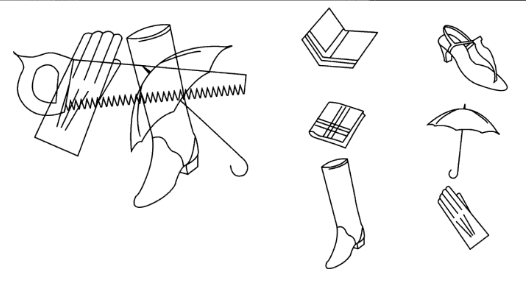
- Apperceptive visual object agnosia (categorisation deficit)
- Primary visual perception failure → patient do not perceive the object normally
- There is no disorder of sensation
- Damaged
- Diffuse occipital and parietal lobe
- Testing
- Unable to recognise objects, draw, or copy a figure.
- They cannot perceive correct forms of the object, although knowledge of the object is intact.
- Difficulty recognising pictures from unusual views
- Associative visual object agnosia
- Disconnection of what (Ventral) pathway
- The primary perceptual analysis disconnected from the store of the associative meaning of the percept
- They can draw or copy but do not know what they have drawn.
- They correctly perceive the form
- Damaged
- Left PCA stroke
- Bilateral inferior occipitotemporal cortex + Splenium of Corpus callosum
- Anterior left temporal lobe + Splenium of Corpus callosum
- Storage of semantics
- Testing
- Patient can copy a picture but unsure what they have drawn
- They can tell you what object it is through verbal or tactile sensation, but cannot identify the object visually
Visual face Agnosia (Prosopagnosia)
- Prosopagnosia
- Inability to recognise a person simply by studying their face.
- Patient often can appreciate aspects of faces such as age, gender, or emotional expression.
- Once other means of recognition come into play (for example, if the person has a characteristic voice or gait, etc), this allows access to unique semantic identifying information—that is, there is no loss of knowledge of the person.
- Subtypes
- Apperceptive
- Cannot Match and categorize faces and cannot recognize who they are
- Damage
- Bilateral occipitotemporal gyrus/White matter tracts.
- Fusiform face area
- Associative
- Can match and categorize faces but cannot recognize who they are
- Damage
- Bilateral anterior temporal regions
- Hippocampus
- Testing
- Other types of facial recognition disorder
- Capgras syndrome
- A form of delusional misidentification in which the patient believes that familiar people have been replaced by impostors.
- Theory
- Two streams of identifying a face
- Conscious stream:
- Result in recognition
- Fusiform gyrus of the right temporal lobe
- Unconscious stream:
- Invoke feelings of empathy if it is a liked person
- Limbic system
- Normally, there is no conflict between these parallel streams, and recognition occurs.
- Capgras: Damage to streams of unconscious processing → Dissociation between the conscious stream identifying a person as, say, wife, and the lack of unconscious empathic feelings. → Lack of concordance between these two streams (that is, looks like wife but no feelings of empathy) may therefore be resolved cognitively by the contention that the loved one has been replaced by an impostor (explaining the dissonance).
- Fregoli syndrome
- Is the clinical mirror image of Capgras in that the patient will accuse strangers of being a familiar person in disguise.
- Intermetamorphosis
- A condition where the patient, on looking at a real face, has a subjective experience of the face morphing from one known face into another, and is thought to represent inappropriate activation of face recognition units.
Visual colour agnosia
- Focal impairments of the colour system mirror deficits to the semantic system in general.
- Subtypes
- Achromatopsia
- Loss of the ability to perceive colours.
- Patients usually describe this as like watching black-and-white television.
- VS retinal colour blindness: red, green or blue light blindness; red/green colour blindness will probably confuse blue and purple because they can't 'see' the red element of the colour purple
- Damage
- Medial Occipito-temporal region,
- Esp: lingual and fusiform gyri.
- Has concomitant superior field deficit
- Specific colour aphasia
- Seen in the context of aphasia,
- Disproportionate difficulty in linguistic processing (including naming) of colours
- Damage
- Dominant parietal damage
- Concomitant with posterior (Wernicke's) aphasia
- Colour anomia
- There is both preserved perception and semantic knowledge regarding colour, but simply a deficit in colour naming.
- Can succeed at non verbal colour task
- Can write "blue" but not say "blue"
- Damage
- Dominant occipital + splenium corpus callosum
- Concomitant in patients with pure alexia + Right homonymous hemianopia
- Colour agnosia
- A residual category of patients who have difficulty appreciating the nature or name of colour they see but who do not fall within the previously discussed categories
- Damage
- Bilateral ventral visual stream
- Testing
- Assessing colour discrimination, colour knowledge, and colour naming.
Auditory agnosia
- The inability to understand the meaning of sounds in the context of preserved basic auditory perception
- Wernicke’s aphasia is a form of auditory agnosia for words.
- ‘‘Auditory agnosia’’ tends to be applied to non-verbal sounds—for example, environmental sounds such as traffic, aircraft noise, etc.
- Damage
- Bilateral lesions of the auditory cortex.
- Presentation
- Acute onset, and initially the patient becomes almost entirely deaf—that is, cortically deaf.
- Normally, however, this improves such that the patient hears auditory stimuli.
- Auditory perception returns to normal (tested clinically by the examiner snapping fingers behind patient’s head) but the patient remains unable to identify the sound.
- Although restricted category specific forms may exist, most auditory agnosias refer to a wide group of environmental sounds.
- Classified based on the type of auditory stimulus the patient has difficulty recognizing
- Cortical auditory disorder and cortical deafness
- Patient has difficulty recognizing auditory stimuli of many kinds, verbal and nonverbal.
- Basic audiological testing results are abnormal.
- Subtypes
- Cortical deafness: Patient complains of a subjective sense of deafness.
- Cortical auditory disorder: There is no subjective sense of deafness.
- Over time patients evolve to have one of the 3 following auditory agnosia
- Damage
- Variable
- Superior temporal gyrus and efferent connections of heschl's gyrus or bilateral subcortical lesions
- Pure word deafness
- Patient is unable to comprehend spoken language but can read, write, and speak in a relatively normal manner
- Comprehension of nonverbal sounds is relatively spared
- Patient is relatively free of aphasia symptoms found with other disorders affecting language, comprehension
- Damage
- Bilateral
- Symmetrical lesions of anterior section of superior temporal gyri
- Most often bilateral disconnections of Wernicke's area from auditory input
- Unilateral (rare)
- Deep subcortical in dominant superior temporal region damaging primarily auditory cortex or pathways to and from medial geniculate gyrus
- Auditory sound agnosia (Auditory agnosia for nonspeech sounds)
- Patient unable to comprehend meaning of common environmental sounds with relative sparing of speech
- Condition is far rarer that pure word deafness
- Subtypes
- Perceptual-discriminative form
- Patient makes predominantly acoustic errors
- Eg: Whistling for bird songs
- Damage
- Non dominant hemisphere
- Semantic-associative form
- Patient makes predominantly semantic errors
- Eg: Train for car engine
- Damage
- Dominant hemisphere: linked with posterior (Wernicke's aphasia)
- Sensory (receptive) amusia
- Patient is unable to appreciate various characteristic of heard music
- Impairment in perceptual versus conceptual aspects of music should be evaluated
- Impairment of music perception occurs to some extend in all cases of auditory sounds agnosia and in most cases of aphasia and pure word deafness; exact prevalence is unknown
- Condition is probably under-reported because a specific music disorder rarely interferes with everyday life
- Perception of pitch, harmony , timbre, intensity and rhythm may be affected to different degrees or in various combinations.
- Damage
- Unilateral temporal lobe:
- If has concomitant aphasia then lesion is on the dominant side
Somatosensory agnosia
Cortical tactile disorders
- Deficits are in appreciating distinct object qualities such as seize, shape, weight, or spatial configuration or tactually presented objects.
- Subtypes
- Amorphognosia:
- Impaired recognition of the size and shape of objects
- Ahylognosia:
- Impaired recognition of the distinctive qualities of objects ush as weight density, texture and thermal properties
- Damage
- Rt hemisphere disease: concomitant in patient who have difficulty performing spatial task
Tactile agnosia (Tactile asymbolia):
- Patient cannot identify objects placed in the hand
- Elementary sensory function is intact
- Subtypes
- Deficits in both hands
- Patient has a central defect in processing the nature of a stimulus.
- Patient cannot demonstrate the use
- Deficits in one hand (usually Left): unilateral tactile anomia
- Patient has visual verbal disconnection
- Patient can demonstrate use of the object and can name the object if placed in the other hand
- Damage corpus callosum
 Made with Bullet