
Alexia
- Defects in ability to read
- With regard to perception, language may be accessed through
- Visual modality: reading
- Auditory modality: speech
- Can be due to
- Peripheral: Difficulty in transmitting the visual percept to the intact language centres
- Impaired visual acuity as a result of ocular problems,
- Visual field defect, even if this does not involve central fixation.
- Impaired ability to coordinate eye movements such as
- Ocular motor apraxia
- Saccadic intrusions
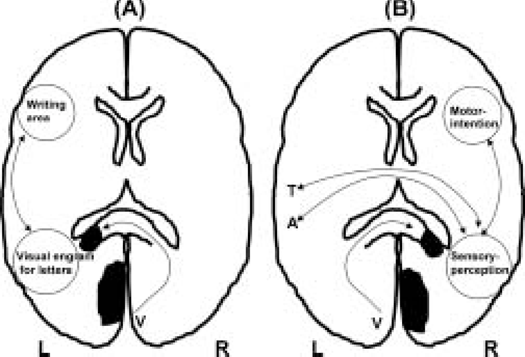
- Alexia without agraphia
- Disconnection syndrome
- Pathology
- Left medial occipital lobe
- Neglect dyslexia
- Difficulty with left side of words or page
- Unable to read the left hand side of words—for example, for SISTER, the patient will only perceive -TER.
- Pathology
- Right hemisphere
- Central: due to an impaired language system
- Surface dyslexia:
- Loss of semantic knowledge
- Difficulty with irregular words
- Pathology
- Left temporal lobe
- Deep dyslexia
- Only able to read via meaning, not be letter by letter
- Unable to read non-words (eg: Chog, Lave)
- Pathology
- Left hemisphere
Alexia without agraphia
- This syndrome is rare and more often overlooked
- A high level visual deficit resulting in inability to read
- Characteristics
- Inability to comprehend written material.
- Can write what he has seen
- Pathways from primary visual cortex to pre-motor and motor cortex involved in control of writing movements are preserved.
- But is then unable to read back what he has written.
- The patient can recognise words spelled aloud, showing that this is an access problem rather than a primary language deficit.
- It is a sort of category-specific form of visual agnosia for words, in some ways similar to prosopagnosia.
- Due to
- Disconnection between visual (Occipital lobe) and language areas (left angular gyrus)
- Lesions affecting the left occipital lobe and the posterior fibres of the corpus callosum.
- Lt PCA stroke
- White matter tracts damaged
- Left occipital temporal pathway-ILF
- Ventral indirect subpathway-ILF/UF
- Often associated with
- Right homonymous hemianopia
- Colour anomia
- Achromatopsia
 Made with Bullet