
Locationist view
- Each region of the brain corresponds to a given function (e.g. Brodmann areas)
- Old view
- Implies that brain injury in an “eloquent” area will result in a massive and permanent neurological deficit.
- However, it is unable to explain the many observations of recovery after brain damage, even in eloquent regions as well as fMRI and intraoperative mapping evidence of pre- and postoperative cortical topographic map reorganization in diffuse low-grade glioma patients with “eloquent” lesions.
Brain connectome
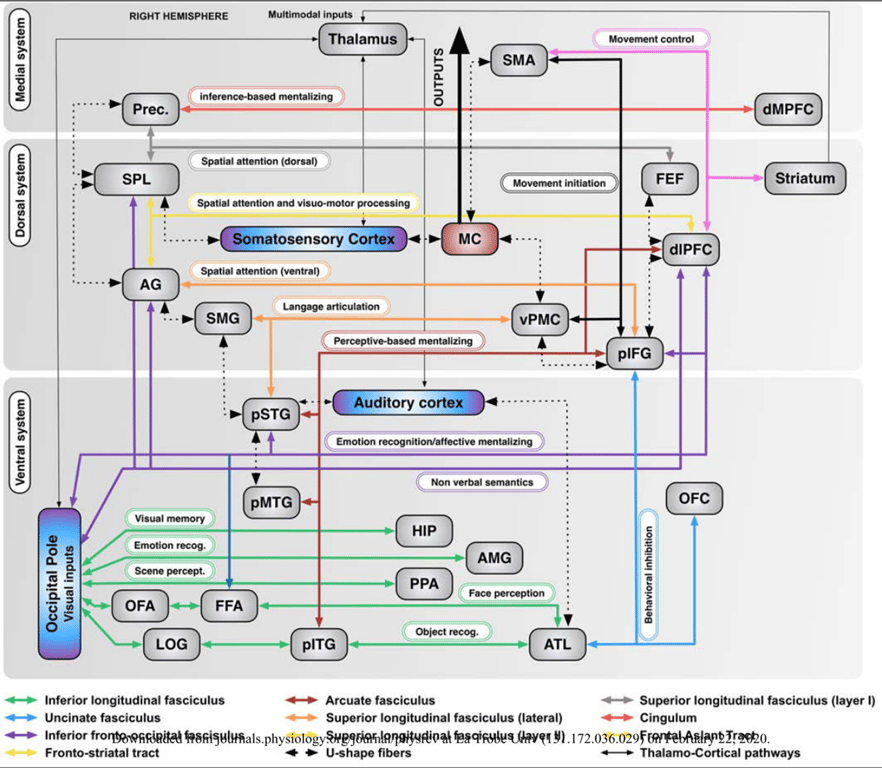
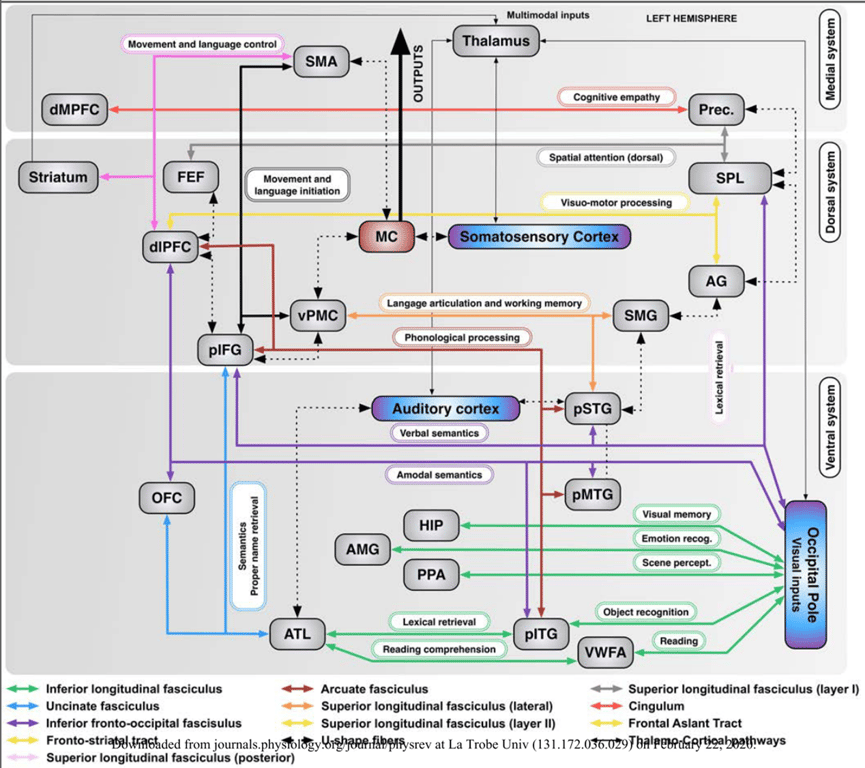
- The CNS is organized into parallel networks, which are dynamic, interactive and able to compensate for each other (at least to a certain extent) has gained favour.
- Hodotopic principle where functions of the brain are supported by extensive circuits comprising both the cortical nodes (topos) and connections between them created by associating bundles of white matter (hodos).
- Neurological function arises from the synchronization between different nodes, working in phase during a given task, and the same node may take part in several functions depending on the other cortical areas with which it is temporarily connected at any one time.
- Functional maps may be reorganized within remote networks over time, making neuroplasticity mechanisms possible.
- Modest redistribution of neurosynaptic networks occurs in acute injuries (e.g. stroke) explaining the limited recovery, whereas massive redistribution of function can occur in chronic slowly progressive injuries (e.g. DLGG) so that an “eloquent” location generally does not result in functional deficit.
- Cortical map reorganization mechanisms involve recruitment of areas around the lesion and/or within the hemisphere remote to the glioma and/or contralateral to the lesion. However, the plasticity index is high for cortical reorganization but very limited for subcortical connectivity hence it is crucial to preserve functionally important subcortical white matter (determined by intraoperative white matter functional mapping), allowing post injury/operative cortical map reorganization and avoidance of permanent neurological deficit.
- In this way, supratotal resection of diffuse low-grade gliomas (i.e. to the functional limit defined by intraoperative white matter mapping, rather than to the tumor limit defined by FLAIR MRI) has been supported by some surgeons.
- While this approach may tackle microscopic tumor spread, all cases must be done awake with functional mapping, requires a large craniotomy, and is seen as too aggressive by many at present.
Metasystem
- Transitory, task-induced changes in integration between brain regions encompassing specialized functional systems. This cross-systems interaction allows the resulting meta-systems to support functions that transcend those of specialized networks
- Lesion-related cortico-cortical disconnections should be associated to marked cognitive impairments
- Damage to the SLFII, which provides cortical projections in associative areas belonging to both the ventral and the dorsal attention network, is associated with severe forms of spatial neglect, because SLFII allowing these networks to cooperate in normal physiological circumstances
- Dorsal aspect of the posterior cingulate cortex (PCC)
- F(x): Central role in coordinating functional transactions between otherwise more segregated networks
- A ‘central’ cortical structure in performing cross-system integration and thus permitting the instantiation of transient functional meta-systems physiologically reflecting the current cognitive demands
- Damage of tracts arising from PCC causes altered but transient state of consciousness mainly characterized by a behavioral unresponsiveness and a loss of environmental connectedness
 Made with Bullet