
General
- A dysraphic condition
- When segments of the spine and spinal cord fail to develop properly.
Diagnostic criteria
- Paraparesis/paraplegia, including lower limb aberrations;
- More than one segment vertebral abnormality which may include kyphosis or kyphoscoliosis;
- The absence or malformation of a portion of the spinal cord, along with associated nerve roots anywhere from the cervical spine to the sacrum;
- The presence of spinal cord distal to the affected region of cord.
Mechanism
- Mishap in the development of the early neural tube that results in a nonclosure
Radiology
- Images show marked lumbar spine abnormalities;
- Vertebral body hypoplasia;
- Absent posterior segments in L3-L5;
- Anterior displacement of the sacrum relative to the upper lumbar spine, resulting in a focal z-shaped deformity and kyphosis;
- Diminutive sacrum;
- A low-lying, posteriorly tethered spinal cord adherent to the dura with distorted morphology.
- The arrows across all images indicate the z-shaped deformity and also highlight where the tethered cord is most evident in magnetic resonance images B and C
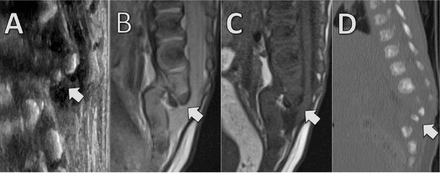
(B) sagittal T2-weighted magnetic resonance imaging (MRI),
(C) sagittal T1-weighted MRI,
(D) sagittal reconstruction of a noncontrast computed tomography scan.
 Made with Bullet