
General
- The most common mutation (∼ 90%) in glial brain tumors
Subtypes
- IDH composed of three types of isoenzymes (IDH1, IDH2, and IDH3)
- IDH1:
- Localize in cytoplasm and peroxisomes
- NADP+ dependent
- IDH2:
- Localize mitochondria (TCA cycle)
- NADP+ dependent
- IDH3:
- Localize mitochondria (TCA cycle)
- NAD+ dependent
- No mutation has been detected in human cancer
IDH functions
- Wildtype: isocitrate → alpha-ketoglutarate
- Mutated:
- Alpha-ketoglutarate → D2-hydroxtglutarate (2-HG) in a NADPH dependent manner
- Most common IDH mutation: R132H mutation (arginine → histidine132)
- Found in 5.6– 12% of GBM patients
- Confer a better
- Progression-free survival (3.7 years)
- Median survival (1.1 years)
- IDH mutation are almost always heterozygous and both mutant and wildtype are required for 2-HG production in glioma cells
Tumorigenesis mechanism
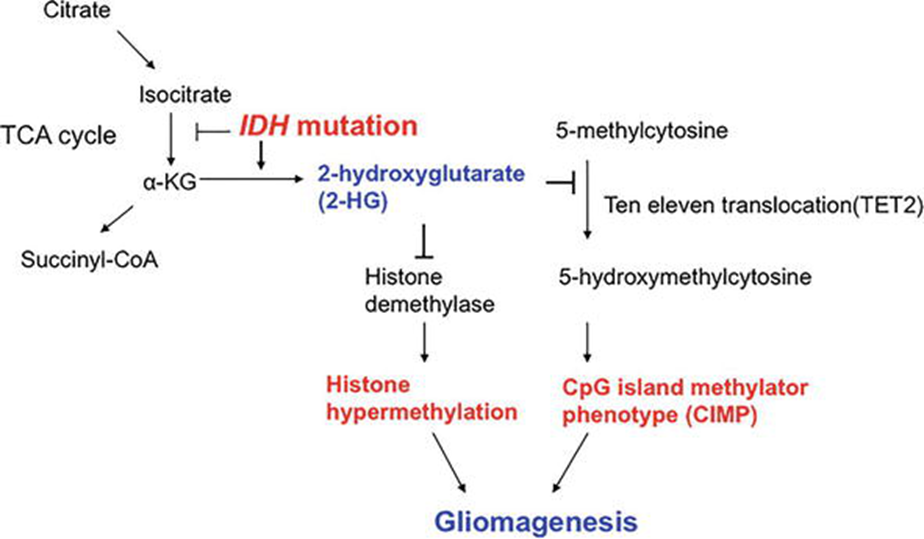
- IDH mutation drive production of oncometabolite D-2-hydroxyglutarate
- Alpha glutarate → D2-hydroxyglutarate (2-HG)
- 2-HG has a similar structure to alpha-ketoglutarate
- 2-HG can inhibit a variety of alpha-ketoglutarate dependent dioxygenases eg: 10-11 translocation-2 (TET2): induces global demethylation of DNA by catalyzing the conversion of 5-methylcytosine (5-mC) → 5 hydroxymethylcytosine (5-hmC).
- CpG island methylator = DNA methylation + histone methylation changes the epigenetics of the cell to induce glioma formation (by silencing genes)
- IDH thru the formation of 2-HG by affecting α-KG-dependent prolyl hydroxylases can also affect a cell's hypoxic status to induce angiogenesis
- MRI features
- Wildtype
- Heterogenous T2w hyperintense mass with enhancement and restricted diffusion within the solid components with extensive perilesional signal abnormality
- Mutation
Predicting IDH
- MRS can be used to detect 2-HG
Presence in tumour
- IDH mutation present in 70-80% of secondary GBM but only 5% of primary GBMs
- IDH mutation in grade 2/3 gliomas
- Wildtype is rare for both
- Little prognostic difference between IDH mutant grade II & III astrocytoma
- IDH mutant cases do better than wildtype for both diffuse and anaplastic astrocytoma
- Tumours can lose their IDH mutation over time
- Oligodendroglioma
Testing
- Complex
- Takes 2-3 days
Outcomes
- Showing IDH wildtype has worst outcome; IDH mutant has better outcomes only for oligodendrogliomas but IDH mutation has no bearing on outcomes for grade 2 astrocytomas
- Conclusion: The integration of genomewide data from multiple platforms delineated three molecular classes of lower-grade gliomas that were more concordant with IDH, 1p/19q, and TP53 status than with histologic class. Lower-grade gliomas with an IDH mutation either had 1p/19q codeletion or carried a TP53 mutation. Most lower-grade gliomas without an IDH mutation were molecularly and clinically similar to glioblastoma. (Funded by the National Institutes of Health.)
 Made with Bullet